Parliamentary elections have concluded in Armenia. According to preliminary results announced by the Central Electoral Commission on June 8, Prime Minister Nikol Pashinyan’s Civil Contract party received 49.81% of the vote, thereby retaining its majority in parliament.
This result gives the ruling party the ability to form a government on its own. However, Pashinyan’s party did not secure the two-thirds parliamentary majority required to make constitutional amendments.
The opposition’s claims and the new composition of the parliament
According to figures released by the Central Electoral Commission, four political forces surpassed the electoral threshold and secured seats in parliament:
Civil Contract Party (Nikol Pashinyan): 49.81%;
Strong Armenia Alliance (Samvel Karapetyan): 23.29%;
Armenia Alliance (Robert Kocharyan): 9.94%;
Prosperous Armenia Party (Gagik Tsarukyan): 4.00%.
The leader of the Strong Armenia bloc, billionaire Samvel Karapetyan, which finished in second place, took part in the vote while under house arrest. He is accused of attempting to overthrow the government, but he denies the allegations.
Karapetyan described the election process as “shameful” and stated that his supporters had faced pressure during the campaign period.
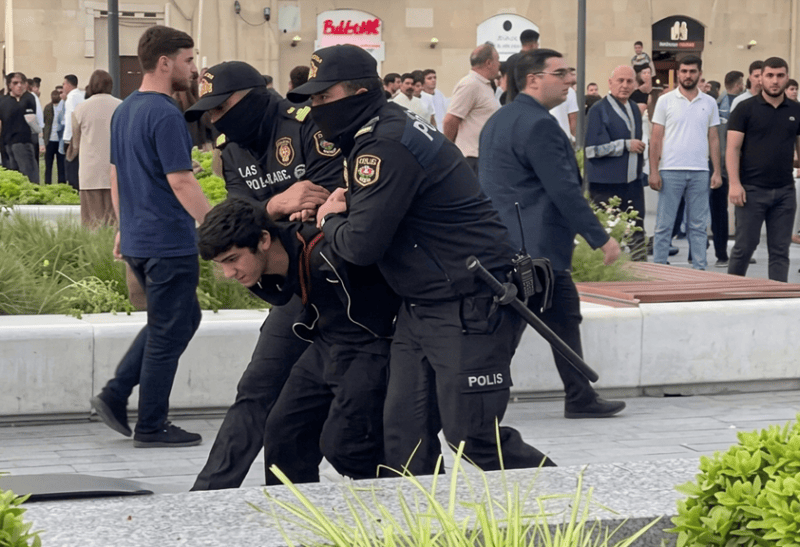
The Armenian Investigative Committee, meanwhile, announced that 59 criminal cases have already been opened in connection with election violations and that 9 people have been detained.
Increase in voter turnout
Voting was held at 2,005 polling stations across the country. Overall voter turnout was approximately 60%. This represents an increase compared to the 49.4% turnout recorded in the 2021 parliamentary elections.
Armenian law does not establish a minimum voter turnout requirement for an election to be considered valid.
The results changed during the vote-counting process on election night. As the initial ballots were being counted on the evening of June 7, Pashinyan’s party was leading with a higher share of the vote. However, after the full processing of ballots from the regions, the ruling party’s vote share fell to 49.81%. Nevertheless, this result was sufficient to maintain its parliamentary majority and form a government on its own.
Foreign policy: Balancing between Moscow and Brussels
Answering journalists’ questions after the vote, Nikol Pashinyan also spoke about Armenia’s foreign policy direction.
Commenting on the crisis that emerged amid the suspension of relations with the Collective Security Treaty Organization (CSTO), Pashinyan stated that Armenia’s ties with Russia are based on institutional foundations. According to him, some claims about tensions in the relationship are being artificially raised by domestic political forces.
The Prime Minister also stated that, from a legal standpoint, Armenia cannot be expelled from the Eurasian Economic Union (EAEU), emphasizing that official Yerevan possesses the same veto rights as the other member states.
Pashinyan also highlighted the expansion of cooperation with the European Union. Referring to a phone call with European Commission President Ursula von der Leyen, he said that the EU will provide Armenia with more than €50 million in direct financial assistance. According to him, special mechanisms are also being developed to allow Armenia’s agricultural products to enter the European market duty-free.
Domestic and international reactions
The ruling party described the election results as a sign of public support for the continuation of reforms and for its policy of closer alignment with Europe.
Opposition forces that entered parliament, meanwhile, stated that they will investigate the arrests and alleged irregularities during the election process through legal channels.
The leadership of the European Union, French President Emmanuel Macron, and Ukrainian President Volodymyr Zelensky congratulated Pashinyan after the vote. They expressed support for continued cooperation with Armenia, the country’s sovereignty, and its course toward closer ties with Europe.
Russian official circles, meanwhile, claimed that there was pressure on the opposition during the election process and emphasized the importance of fulfilling mutual obligations within bilateral relations as well as within the framework of the Eurasian Economic Union on the basis of mutual respect.
Peace with Azerbaijan and the Constitutional issue
One of the key issues that will remain on the agenda after the elections is the peace agreement with Azerbaijan and discussions related to the Armenian Constitution.
Baku has long stated that it will be difficult to sign a final peace agreement unless provisions in Armenia’s Constitution and legal-political documents that could be interpreted as territorial claims against Azerbaijan are removed. This particularly refers to the reference to Armenia’s Declaration of Independence, which includes a reference to the 1989 decision on the unification of Armenia and Karabakh.
Pashinyan, however, explains the idea of a new Constitution not only in the context of the peace process with Azerbaijan but also as part of Armenia’s transition to a new political stage. He presents this within the framework of the concepts of a “Real Armenia” and a “Fourth Republic.”
However, the election results show that although Pashinyan’s party retains a simple majority in parliament, it does not have the supermajority needed to amend the Constitution on its own. This indicates that any potential constitutional changes will not be easily adopted in parliament and that such a process may require broader political consensus or even a referendum.
In this regard, although Pashinyan’s electoral victory gives a political mandate for the peace process with Azerbaijan, the issue of the Constitution remains one of the most sensitive and contentious topics within Armenia.