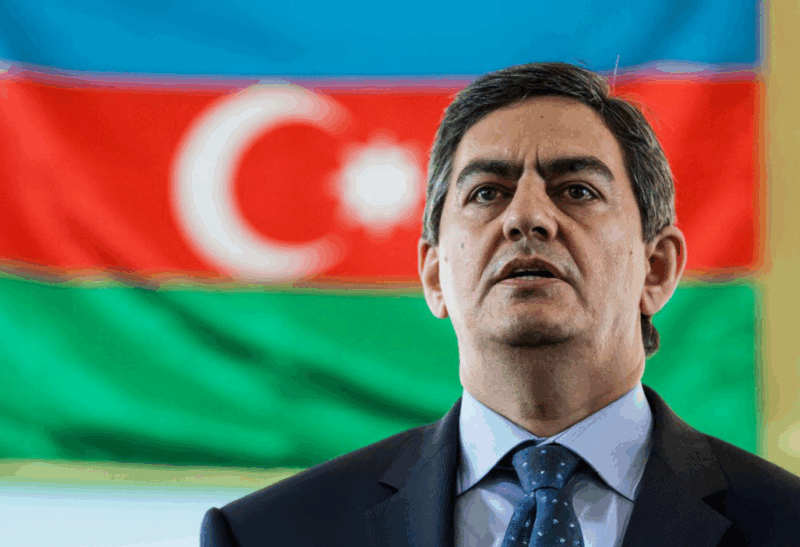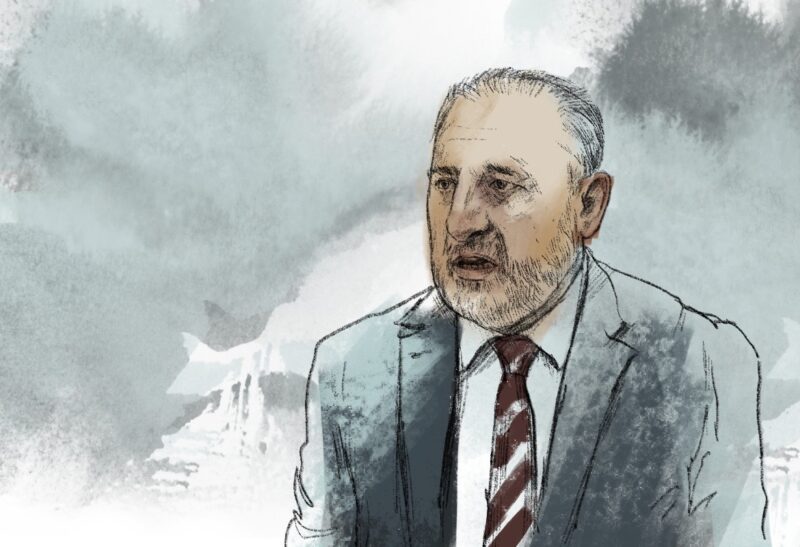
This is not an interview, but a conversation — or rather, a discussion — between two prisoners through iron bars. It could also be called a heart-to-heart between a teacher and a student. Shamshad Agha was a teacher at the “Democracy School,” and Bahruz Samadov was his student.
Shamshad Agha: Bahruz, today is February 6th. It marks one year since my arrest. And you’ve been on a hunger strike for two days. You know I suffer from a stomach ulcer, but I’m ashamed to eat. In general, we are people who feel shame. Perhaps it’s precisely because of our shame that we’re here. I think it was Žižek who said that the most patriotic people are those who feel ashamed of what happens in their homeland. There’s also a crude parable about this — I’ve told it to you. So what troubles you most: physical or spiritual hunger?
Bahruz Samadov: Honestly, physical hunger demands food, while spiritual hunger is oriented toward desire. My desire is, of course, freedom. A hunger strike is, by its nature, built on negation. The refusal here is not only of food — it’s also a desire to renounce the material and reach the spiritual, because access to material comforts is always possible. It is even offered. For instance, in the SSS detention facility, a doctor asked me: “What are you lacking? What bothers you? The cell has everything.” I told him my protest wasn’t about material needs — my spiritual needs aren’t being met. I am, by nature, a person connected to art. But here I cannot see the works of art I want; I’ve been deprived of beauty. Jesus Christ has a famous saying: “Man does not live by bread alone.”
Shamshad Agha: Speaking of man — in societies like ours, the individual always comes second. As in medieval clerical Europe: “everything for the king, everything for the state.” But Europe freed itself from that. The East, however, still operates not around the human being but around the “head of state.” All freedoms, all sovereignty, exist for the sake of the state. And the state is the king, the authoritarian. In this theater, there is no human-centeredness, the director, the screenwriter, the actor, all is the state, i.e., the king. And to me, this is deeply wrong.
Bahruz Samadov: You’re right. This is, as I said, the restriction of individual freedoms in the East. In the East, the concept of human freedom has never really existed. Even romantic philosopher-poets like Nasimi, who valued the human being, remained marginal. Even they were punished by rulers who called themselves “the shadow of God on earth.” This wasn’t only true of the Muslim East, it was the same in the Far East. Buddhism, for example, saw reality as illusion. In such societies, loyalty to the powerful, to the master, was considered the highest moral standard, leaving no room for negation.
Shamshad Agha: I agree. Loyalty to the powerful even refuses questioning and discussion. In today’s language, loyalty to the master negates independent action, politics, and even human freedoms.
Bahruz Samadov: Because politics itself is the act of questioning, of negating something and offering something new in its place. In societies where politics is absent or forbidden, serious questioning marginalizes you as well. The place of politics is taken by kitsch. Truth is so debased that there’s no need for inquiry. When someone questions something seriously, they’re presented as an enemy. That’s why I categorize Azerbaijan’s current political reality as authoritarian kitsch. And authoritarian kitsch alienates people from life. The banal truth this kitsch presents is calculated to draw the collective’s tears. Kundera said: kitsch is the absolute denial of shit — an unequivocal agreement with everything that exists.
Shamshad Agha: Like the Kim Jong-un kitsch we’re rapidly heading toward.
Bahruz Samadov: Exactly right.
Shamshad Agha: As a peace activist, you frequently wish peace upon the region and the world. How can a call for peace be associated with “treason against the state”? By that logic, do the concepts of state and peace negate each other?
Bahruz Samadov: The peace I desire is democratic peace. In democratic peace, there is room for discontent and different interpretations. The peace I want is not built on corridors and pipelines, it exists between people and nations. Do you think peace can be built on economic interests alone?
Shamshad Agha: For a beginning, perhaps it’s normal. Generally, since the dawn of humanity, economic interests have played a serious role in social relations. But I agree that peace must be rooted in people’s minds and thinking. For that, civil society must play an active role in the process. Otherwise, peace will exist when states want it and disappear when they don’t. Peace built solely on economic interests is not sustainable, it’s fragile. The Soviet government put an end to the Armenian-Muslim massacres of 1905–1918 — not more, not less — and a coexistence was formed over 70 years. But the moment the Soviet Union collapsed, the myth of peace and coexistence collapsed with it. The 30-year conflict caused us both territorial loss and occupation, and also obstructed democratic development. In the end, the land came back, but democracy is nowhere on the horizon. What I’m saying is: during the Soviet period, it was the state that wanted peace — there was no civil society. Today too, there’s no guarantee that “because Ilham Aliyev and Pashinyan want it, there will be eternal peace.” Because the main factor always interested in conflict in the region — Russia — is ever-present. That’s why the state can only lay the first bridges, build economic ties; the work that follows falls to civil society. And that civil society must be independent, not conducted with a baton.
Bahruz Samadov: That’s exactly why the dismantling of independent civil society in Azerbaijan is a dangerous trend. Those who join the process under the name of “civil society” are guided by and move according to the narratives of those in power.
Shamshad Agha: Bahruz, if we go back ten years, our acquaintance dates to 2016. You were a student at our “Democracy School.” Even then you had distinctive perspectives. But we couldn’t have imagined that some prison, ten years later, would bring us together: a teacher and a student. What we once called “the future” for a particular era has been left behind, it is now the past. So what must be done to bring a new future?
Bahruz Samadov: As you said: one must stay positive, look to the future with hope, keep working without stopping, without losing heart.
Shamshad Agha: Yes. Behind every effort lies a reason, and behind every reason, a purpose…
A brief history of the arrests and charges against the journalist and political analyst
An Azerbaijani journalist, co-founder of the media platform Toplum TV and editor-in-chief of the website Argument.az. Shamshad Agha cooperated with Meydan TV, serving as an editor and writer of articles critical of the government.
He was arrested on the night of February 5–6, 2025, as part of the Meydan TV case. He and 12 other journalists were charged under several articles of the Criminal Code, including smuggling and economic crimes.
Bahruz Samadov is a political analyst, researcher, and former doctoral candidate at Charles University in the Czech Republic, known for his critical publications about the situation in Azerbaijan, including the conflict with Armenia and restrictions on freedoms.
On August 21, 2024, he was detained by the State Security Service and charged with high treason under Article 274 of the Criminal Code of Azerbaijan.
In June 2025, a Baku court sentenced Samadov to 15 years in prison, a verdict that he and his supporters describe as fabricated and aimed at suppressing criticism and freedom of expression.
Samadov has repeatedly stated that the accusations of cooperation with Armenian intelligence services are not supported by evidence and are being used for repression.
He also went on a hunger strike in protest against his arrest and sentence.