My attempts to make my voice heard as a trans person in Azerbaijan began when I was very young. When I first got involved in activism, I always heard the phrase, “This road has no end in this country!” From what I have seen over the years among friends and the community, most queer people live in constant fear of having to leave. In recent years, Azerbaijan has increasingly become a closed society politically and socially. Unemployment, political pressures, restrictions on freedom of expression, and fear for personal safety force more young people to leave the country. LGBTQ+ youth experience this process with double discrimination. On one hand, they are affected by general political and economic pressures; on the other, they are specifically targeted by their families, workplaces, and state institutions because of their sexual orientation and gender identity.
My own decision to leave a country where I constantly lived under surveillance and anxiety intersected with the paths of other Azerbaijani LGBTQ+ people striving to live independently in various parts of the world. Looking more closely at the stories shared by community members, it becomes clear that leaving Azerbaijan is not a personal choice for LGBTQ+ people, rather it is the result of the lack of legal protections, police violence, and a system that fuels queerphobic pressures in society. For those living under constant risk, migration is not a matter of opportunity but a necessity, as remaining in Azerbaijan becomes impossible.
“I accepted a forced marriage with a man in Turkey in the hope of living freely”
Lamiya*, a 27-year-old lesbian who was forced into marriage to escape her family’s pressures and moved to Turkey, says that the first pressures began in her childhood.
“I was about 11 or 12. I remember constantly talking to my mother about girls, beautiful girls. I would say I liked a female classmate. One time I said it so much that my mother hit me. For a very innocent sentence.”
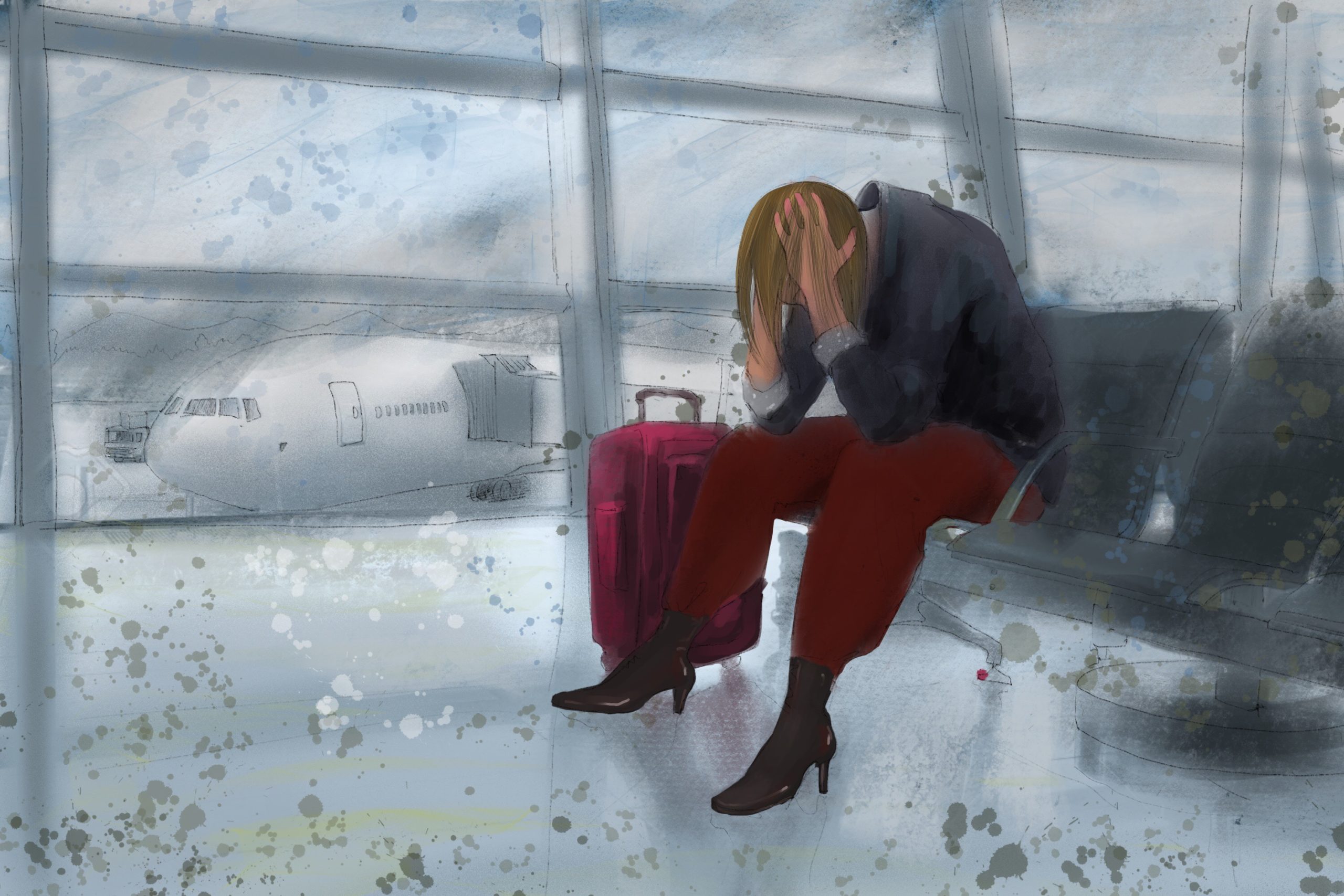
“I would come up with different excuses for my family each time. I said I would go to university and then get married, or work first. Sometimes I was forced to meet men my family chose, but I couldn’t say that there was another woman in my life. By the time I turned 22, I had no place left to run. At that point, I tried to reach out to communities I knew from social media to find support and escape abroad. But we couldn’t find support. We thought about going to the police, hoping they might help. The lawyer I spoke to told me, ‘If the police find out you are a lesbian, they will threaten to tell your family themselves.’ We were trapped. My relatives are conservative; they wanted to force me into marriage. I thought, at least I could move to another country. Hoping to live freely there, I agreed to a forced marriage with a man in Turkey. I even left the country without saying goodbye to the woman I loved.”
In Azerbaijan, forced marriages, domestic violence, and lack of rights push women toward more dangerous “escape routes.” The patriarchy, supported by the state, creates double challenges for queer women. Women who deviate from the “national value” model are punished by families and left alone because state institutions normalize and deliberately ignore this violence. As a result, community members are influenced by all these factors, leading to forced marriages, fake relationships, or unplanned migration. They leave the country without any legal or social guarantees, forced to build a life from scratch in unfamiliar societies.
Lamiya tried for a long time to convince herself she liked men to cope with the forced marriage. According to her, after the wedding, she had to live through compulsory sexuality and from that moment on started looking for ways to escape.
“I came to a city I didn’t know. I felt lonely in the chaos. I couldn’t leave the house alone; I thought Istanbul was just what I could see from my window. I lost all my social life and had panic attacks, overwhelmed by these emotions. I had to hide my orientation not only from my family but also from my legal spouse.”
Lamiya’s life changed after seeing news about a feminist rally in Ankara. She saw a video of women holding tightly together, so united that the police could not separate them. That was when she decided to find those women.
“I spent hours researching, asking, ‘Who are these people?’ Then I found the feminist group. I gathered the courage to attend their next event. When I arrived, I just said, ‘I saw you on the internet.’ They simply told me, ‘Come in.’”
From that moment, Lamiya’s life changed, and she began organizing with feminist activists. She says she now lives more freely than in Azerbaijan. Yet being unable to return to her home country still makes her feel incomplete:
“Sometimes I still don’t know if I belong anywhere. I’m safer here, I know that. Whenever I see news from Azerbaijan, I think people live like robots. The lack of hope for my country’s future, feeling alien in the place I was born. It’s very difficult.”
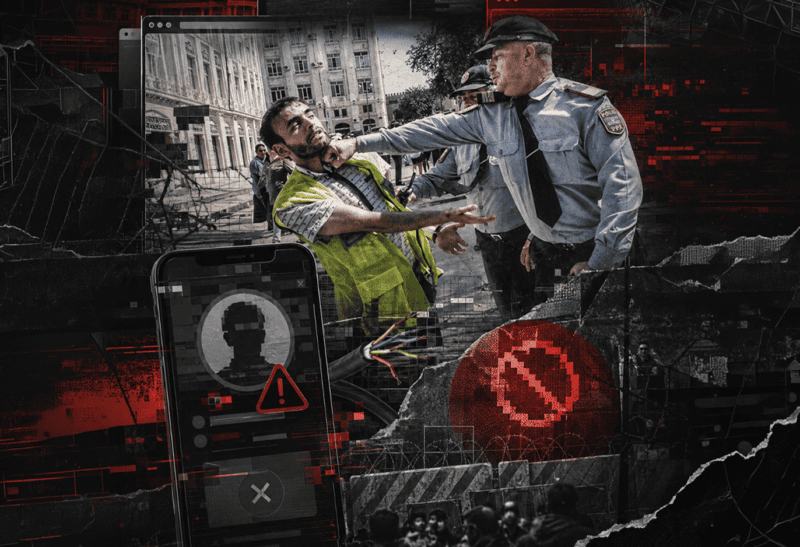
According to the LGBT+ Media Initiative “Qıy Vaar!”, in January and December last year, police conducted raids against queer citizens in Baku and Sumgayit, extorting money from some. Police initially created fake accounts on dating apps to meet community members. After gathering information, they summoned LGBTQ+ individuals to police stations under the pretexts of “online fraud” or “bank issues” and subjected them to physical violence, threatening to expose their personal information to families and workplaces to extract money.
“They would tell me, ‘Scream, do you think anyone will hear you?’”
Nurlan*, 30, originally from Sumgayit and now living in a small Dutch town, is one of them.
He says he first realized he was gay around ages 14–15:
“At home, when they saw a queer person on TV, they’d say, ‘Look at this, is it a boy or girl?’ I grew up with these phrases. I always felt guilty. I tried getting closer to religion, hoping I would change. It didn’t help. I decided to live in hiding. I didn’t want to be pointed at.”
“I always knew I would have to leave this country one day, but I never imagined I’d face this kind of ordeal. It was late December. I was caught in one of these raids. They called me to a local station under the pretext of a network crime. Until I entered the station, I had no idea what was happening. A tall, dark-skinned man approached and said, ‘You sent naked pictures to people,’ claiming there were complaints. I was sure I had sent none. In small towns like Sumqayıt, they threatened to expose my family and work, demanding 2,000 AZN. They humiliated me with questions about my sexual life and laughed at my messages. I had to pay to save my life.”
On January 9, he was summoned again and continued to be threatened. Nurlan describes being dragged into a car, beaten, and forced to open his phone, with his messages used for further threats:
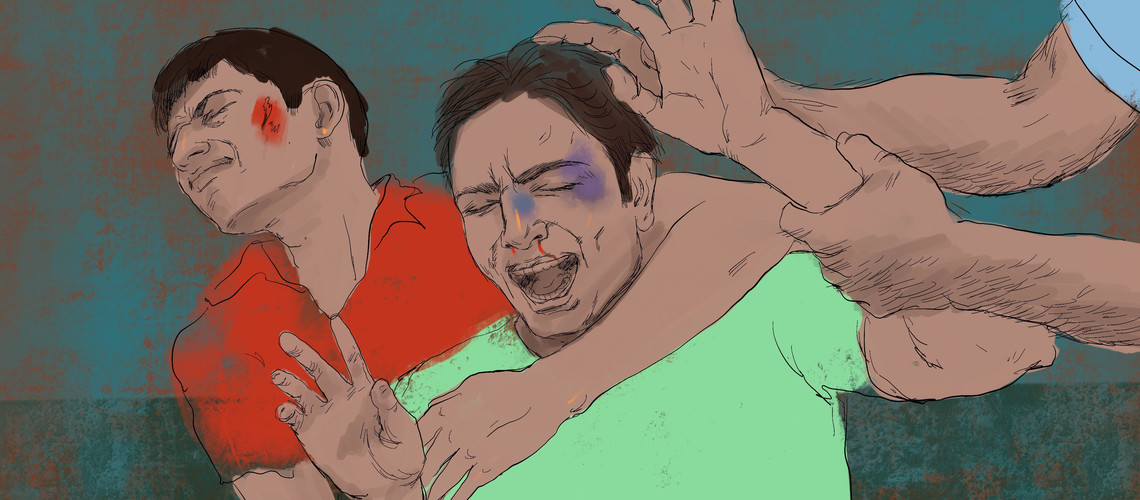
“I still know people who have been summoned to the police 3–4 times under the same pretext. We were at a friend’s place; it was 11 p.m., the New Year holiday had just ended, and we were about to go out into the city. As we were walking quietly, we noticed a group of people in plain clothes following us. Suddenly, one of the police officers shouted, ‘There they are, catch them!’ We didn’t even realize who was trying to grab us. They dragged us along the ground and forced us into a car. In the car, they tried to silence us by shouting and hitting us. Our knees and arms were crushed. We secretly dialed 102 with our phone, but at that moment they took the phone from us and ended the call. What could we do then? They took me to a separate room, and a police officer named Namiq forced me to unlock my phone. They opened my messages with my partner and took them for future threats. They were hitting us with their fists; I frequently lost my balance, and my hands were handcuffed. They would say to me, ‘Scream, do you think anyone will hear you?!’ I remember them kicking my body—they hit me so much that I lost consciousness.”
When Nurlan first arrived in the Netherlands, he was offered support through programs designed for refugees, but he says that even recalling the events he went through is difficult for him. For queer migrants coming from authoritarian regimes where state institutions are sources of violence, it is not easy to trust a psychologist or social worker connected to the police or government. At first, the very idea of “help structures” is associated in our minds with danger.
Nurlan says that at the police station, they forcibly pulled down his pants and began threatening him with sexual assault. To break his resistance, they handcuffed him and threw him to the ground while a group of police officers attacked him. According to Nurlan, an older officer who entered the room also began recording the torture on video.
After these events, Nurlan was threatened again for money and, unable to pay, had no choice but to leave the country for fear that his family would find out. He says he decided to flee to Europe, leaving his family and home behind.
“When you interact with an ordinary person in the Netherlands, you realize how different the culture we come from is. People here cannot fully empathize with what we have been through.
In Azerbaijan, for nearly 30 years, I couldn’t even answer the question ‘Do you have a partner?’ Here, I realize I am just like everyone else.
“I always hid myself, thinking I was different from everyone else. Over time, I even began to believe that I wasn’t normal. Now I am not in a police state and I am happy to have fundamental freedoms, but I no longer know where I truly belong.”
Raids, murder, and a silenced community
On December 27, police conducted a raid at the “Labyrinth” club in central Baku, which is frequented by the queer community. According to community members speaking to Meydan TV, a total of 106 LGBTQ+ citizens were detained during the raid. Some of those detained, speaking on condition of anonymity, reported the treatment they faced at the Nasimi District Police Station. According to them, they were forced to stand for hours, subjected to physical violence, insults, and humiliating behavior. They were not allowed to use the restroom, and no assistance was provided to those whose condition worsened. At the same time, community members reported that police officers demanded money, applied psychological pressure, and in some cases, committed sexual violence.
On November 4 last year, 19-year-old queer Yasin Ibadov was stabbed to death on Bashir Safaroghlu Street in Baku by a paternal relative. Witnesses told the media that bystanders did not intervene, and the police arrived at the scene only after the perpetrator himself called. It was reported that medical assistance was not provided in a timely or adequate manner.
According to ILGA-Europe’s 2025 “Rainbow Map,” Azerbaijan ranks second-to-last among 49 European countries, just ahead of Russia. Although the Azerbaijani government constantly declares respect for tolerance and diversity, its indifference to human rights violations in practice paints a picture of insincerity toward the LGBTQ+ community. Independent researchers often note that Azerbaijan’s relations with Europe are largely driven by economic interests, with human rights not being a priority. The government does not hesitate to use LGBTQ+ identities as a tool to target opposition figures. During election periods and recent crackdowns, the government has repeatedly portrayed independent media and activists as “threats” to the state by linking them to Europe. For example, during the 2024 presidential elections, when I participated as an observer on my own initiative, the government accused independent observers (including me) of receiving funding from Europe. Pro-government news sites highlighted my LGBTQ+ identity without concern for my safety, smearing me in the process. At a time when even the smallest independent work in Azerbaijan is criminalized, the queer community is naturally deprived of the ability to organize and speak out against violations.
*Respondents’ names have been changed for security reasons.